


Of all the amazing running events in Moab, the Moab 240 perhaps takes the “toughest” crown: the route loops 238.3 miles, beginning and ending in Moab. Runners pass by Lockhart Basin, the La Sal Mountains, the Abajo Mountains, and Arches and Canyonlands national parks, climbing 31,000 feet. Runners must finish the event, which takes place every October, within 117 hours.
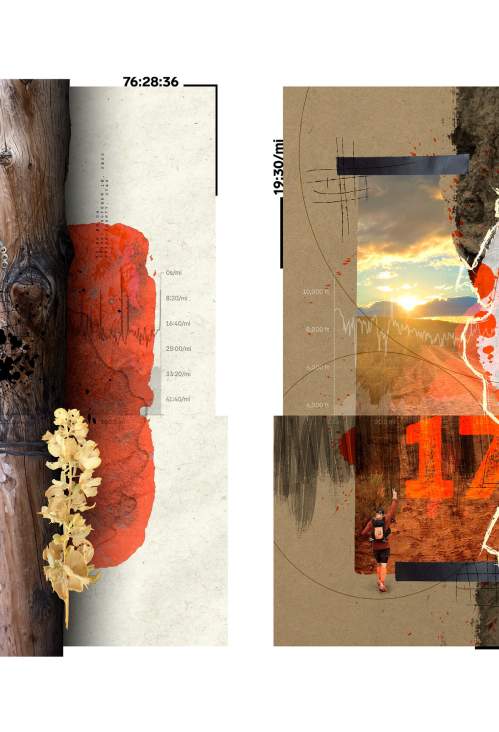
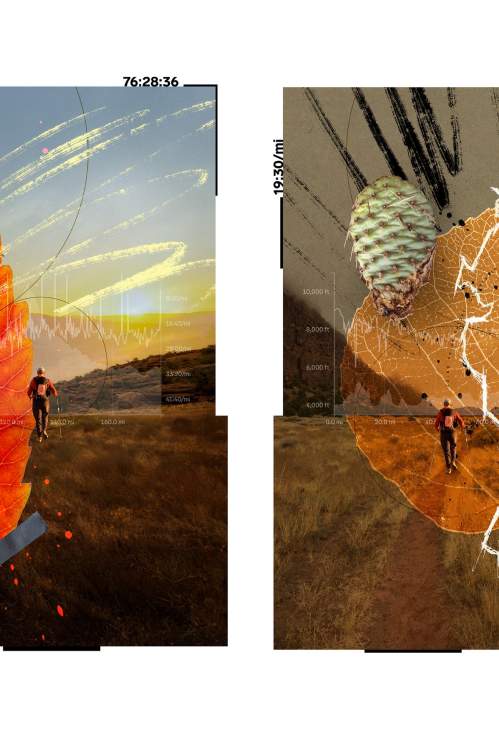
It’s quite the accomplishment—and one that collage artist Lee Willett just checked off. In January 2023, Willett started his trail running art project, “All These Miles,” which he describes as “a visual journal meticulously chronicling each run”; he just published seven collages inspired by the race. While Willett didn’t complete the full course—he ran 178 miles in 76 hours—he said he’s proud of what he was able to do, and he enjoyed every one of the hours he ran.
Read our chat with Willett, and explore his collage works, below.
MOT: How long have you been an artist? What got you started in digital collage?
Willett: My professional training is that of a graphic designer, though I’ve always kept a camera on hand since I learned photography in high school many years ago. I’ve been trail running for over 15 years and always packed a camera in my car in case I saw something of interest or to take group photos of my trail running community.
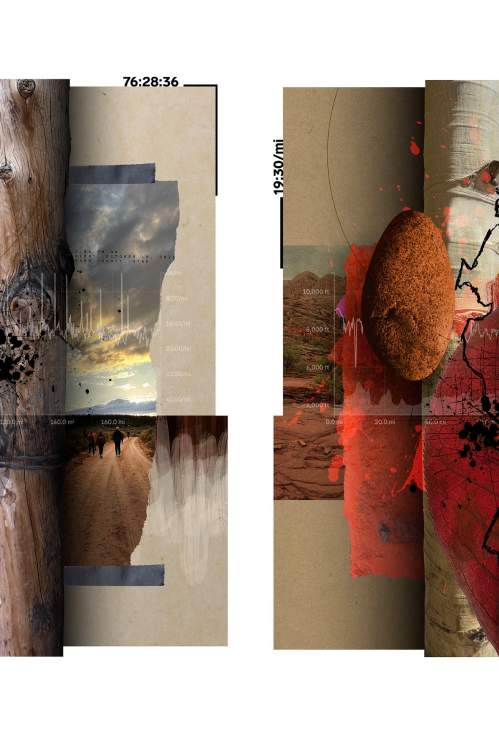
Almost three years ago, I started a project that I call “All These Miles” that combines my photography with my love of trails. For every run, I would take photographs and collage those with information from the run—the distance, route, elevation profile, pace, and time out. Each digital collage serves to document that run and in the case of Moab 240, I created several pieces for that event. While each piece in the series is created digitally, the final artwork is printed on canvas and stretched, then I often add additional media on the print so that each is unique. I currently have a solo show in Bedford, New York, and have had pieces exhibited in different galleries including the Sedona Arts Center.
MOT: What was your experience like running the Moab 240? Have you run it before? Was this the first time?
Willett: Coming to Moab was a kind of homecoming for me. When I was growing up in Ohio, my parents would drive every two years across the country to visit family in California. One year, they took route 70 and made a bypass to Moab, Arches, and Canyonlands. As a child from the midwest, the memory of the beautiful scenery was inspiring and I knew one day I would return. The Moab 240 offered the perfect opportunity to experience the landscape up close in all its variations and it did not disappoint.
This was my first 200+ run—my longest previous run was 100 miles. The format of the longer distance is very different in that it forces runners to stop, sleep, and gives more time to reflect and enjoy the environment. One of my most memorable moments from the run was as the moon was beginning to peak over the horizon: my pacer stopped and turned off his headlamp, urging me to do the same. I did, and we both stared straight up at the splendor of the Milky Way overhead. Had I been able to capture that with my phone, I would have used that in one of my collages, but that is relegated to memory.
MOT: Do you think about what the collages will look like as you run, or do they come to you afterward?
Willett: I never pre-concieve my work before I get back to the studio and review what I have to work with. I’ll see things along the way that I know will be useful, but those are only pieces and not entire designs. In a number of the pieces I created for this event, I used an orange trail blaze that I photographed toward the end of the first day while traversing a field of slickrock. The memory of me stopping to pull out my phone and carefully snap the photo will always stay with me.
I also included myself in these pieces using photographs shot from behind by my pacers. It seemed fitting that after 178 miles and 76 hours, I should include a human element as a testament to the undertaking. While I didn’t finish the 240 miles, the rain this year made for a very challenging course and I’m proud of what I was able to accomplish. Nine friends from the New York area came out to crew and pace me, many of them visiting Moab for the first time. They were all in awe exploring the canyons and mountains nearby and understood why I chose this race as my first 200. It is truly a special place.
As I heal up from the race, I’ve already set my sights on Bigfoot 200 next August in Washington State, but I’d be lying if I said I would never return to this race. For the 76 hours I was on the course, I loved every minute.
You can follow Lee Willett on Instagram and Facebook. Lottery registration for the 2026 Moab240 opens in January.