- What is tamarisk?
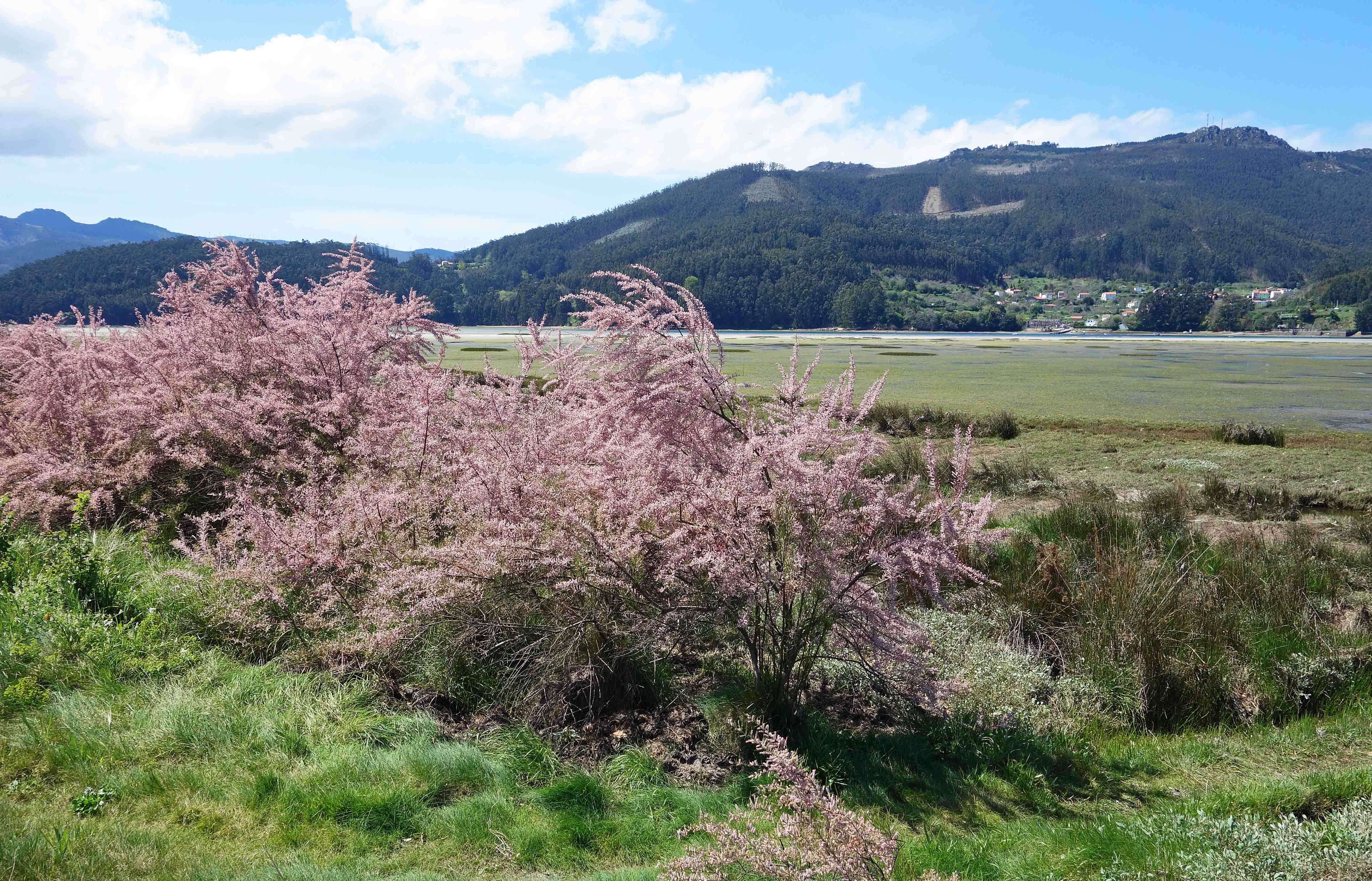
Tamarisk (also known as salt cedar) is a deciduous shrub or small tree from Eurasia. Tamarisk can grow as high as 25 feet tall. The bark on saplings and young branches is purplish or reddish-brown. Leaves are scale-like, alternate, with salt-secreting glands. Flowers are small and the petals are reddish, pinkish, or white. Each plant can produce as many as 500,000 seeds annually. The seeds are dispersed by wind, water, and animals. Seeds are small with a tuft of hair attached to one end enabling them to float long distances by wind and water. Seeds are short-lived and can germinate within 24 hours after dispersal, sometimes while still floating on the water.
- How did it get here?
Eight species of Tamarisk were first brought to North America in the 1800s from Southern Europe or the eastern Mediterranean region (DiTomaso 1998). The species were first planted as ornamentals and later as windbreaks, and to stabilize river banks. Tamarix species escaped cultivation and are now widespread throughout the United States, with heavier concentrations in the Southwest.
- Why is it considered a problem?
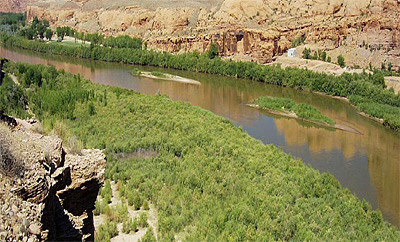
Tamarisk grows in dense, nearly impenetrable thickets. It also is well-adapted to alkaline (salty) soils. The soils of the southwest are naturally alkaline, but with the construction of dams, rivers are no longer able to flush salt from the ecosystems and soils are becoming even more alkaline, which deters general plant growth. Tamarisk creates even saltier soils by bringing up alkaline water which is deposited on the leaf surface. The salt returns to the upper soils via leaf drop. Tamarisk plants are thriving in the alkaline soils and replacing native vegetation, altering the ecosystem.
- Tamarisk has additional negative effects on the surrounding environment by:
- narrowing and channelizing streams and rivers;
- displacing native vegetation such as cottonwoods, willows, and adjacent dryland plant communities;
- providing poor habitat for livestock, wild animals, and birds: the foliage and flowers of tamarisk provide little food value for native wildlife species that depend on nutrient-rich native plant resources;
- increasing wildfire hazards;
- limiting human and animal use of the waterways;
- What is the urgency in dealing with tamarisk (why now)?
Unfortunately, tamarisk has displaced native vegetation on approximately 1.6 million acres of land in the Western United States and continues to spread. It is also a phreatophyte (or a plant that mines the water table). Studies have shown that a mature tamarisk can uptake nearly 200 gallons of water a day. Although native trees in wet riparian areas can use more or less the same amount of water, they do not grow in as densely as the tamarisk. Due to this, the West is probably losing from 2- 4.5 million acre-feet of water per year because of tamarisk. This is enough water to supply more than 20 million people with water for one year or to irrigate over 1,000,000 acres of land.
- What methods have been used to control tamarisk?
Chemical methods involve cutting the stump of a tamarisk two inches above the soil surface and treating it with herbicide within minutes. Another herbicide can be applied near the base of the trunk when the bark is not wet or frozen. Tamarisk foliage can also be sprayed with herbicide in the fall. Unfortunately, re-growth often appears with any of these methods and re-treatment is necessary to kill the shrub.
Mechanical controls include mowing, cutting and root plowing. However, these methods rarely kill the plant and often stimulate shrubby re-growth. Tamarisk is also adapted to fire and recovers more quickly than native riparian species after a burn because it sprouts vigorously from the root crown.
Biological controls use living organisms to suppress tamarisk. The extensive invasion of tamarisk has justified the search for a suitable biological control agent. The tamarisk or saltcedar leaf beetle, Diorhabda elongata, has been tested for 20 years and has been released at test locations in the western U.S.
- What is the role of the beetles (biocontrol)?
Beetles are a biological control used in efforts to reduce or eradicate tamarisk. The beetles are a natural control agent from areas in the world where tamarisk originated. After much study, the beetles were brought to the U.S. in an attempt to stem the tide of the tamarisk invasion. Beetles and larva consume the foliage of the tamarisk plant, thus reducing chlorophyll production and photosynthesis, which reduces the food (starches and sugars) that is made for the plant. This process should weaken and potentially kill the plant over time.
- When and how were the beetles released?
Tamarisk biological control began in the 1970s with the study of potential control insects by USDA-ARS (United States Department of Agriculture – Agricultural Research Service). Quarantine testing of insects began in 1992. Approval to begin field testing was given in 1999 and the beetles were released in outdoor cages in research areas at 10 sites in 6 states (CA, NV, UT, CO, WY & TX). In 2001, the beetles were released from the cages at these 10 sites.
In 2004, A.P.H.I.S (Animal and Plant Health Inspection Service, USDA) personnel opened the Delta, UT, site to the collection of the tamarisk beetles and larva for Utah agencies and organizations and subsequent release of collected beetles and larva within Utah. Beetles and larva could be moved and released on private and certain state lands (no federal lands). Individuals from Grand County, with knowledge of biological control, collected beetles and larva from the Delta site and distributed them to approved sites in Grand County, with two sites receiving two separate releases in 2004.
- How long will it take for the beetles to kill off the tamarisk?
To “kill off” a tamarisk plant without chemicals or removal of the total plant and roots from the ground is difficult. However, repeated defoliation of the plant leads to a reduction in photosynthesis and thus food for the plant/roots. Each time the plant is defoliated should result in a decrease or dying off of some of the root mass. If this happens repeatedly and the plant isn’t allowed to grow new foliage and retain it for an extended length of time, it is possible to kill the plant. Estimates on die off of the tamarisk due to defoliation via the beetle suggest 3 to 5 years, but this could be longer or shorter depending on the size of the plant and its root mass, how often it’s defoliated and how limited the time is that the plant retains foliage.
- Will these beetles eat other types of vegetation?
Extensive testing was undertaken and some non-target feeding was seen on Frankenia. There are four native species in the southwest that are related to tamarisk/saltcedar but not closely related. They are in a different plant family (Frankeniaceae) with tamarisk being in the plant family (Tamaricaceae) but both plants are in the same plant order (Tamarricales). Studies suggest that the larvae could feed and develop on Frankenia but the studies also showed the adult beetles were much less attracted to this plant, and they laid eggs much less frequently on Frankenia than on tamarisk. The second generation of beetles was even less likely to lay eggs on the Frankenia.
- Are there any predators that could control the beetle population?
Birds have been known to feed on the beetles and there are reports of a wasp that parasitizes the beetle. However, when an insect only feeds on one plant and when that plant population is reduced or eliminated, the population of that insect drops off dramatically. Should the beetles significantly reduce the tamarisk population locally then the beetles themselves will die off and be reduced.
- Are there other areas where the beetle is being used to control tamarisk?
There are the six states where initial studies and releases took place (CA, NV, UT, CO, WY & TX). There are a number of sites in Utah where the beetle has been released since 2004, and in August 2005 there were also 24 sites in Colorado, Idaho, Kansas, Montana, Oregon, South Dakota and Wyoming where releases took place. There may have been more releases at these and other sites since.
- What happens after the beetles have defoliated the tamarisk?
Once the tamarisk has been defoliated it can no longer photosynthesize and eventually this will kill the tree. Estimates vary and can depend on several variables including the vigor of the tree and the duration of exposure to the beetle. Recent observations from the Delta, Utah, release site indicate that a tree can be killed within 3-5 years of beetle infestation.
- What will happen when the trees die?
Natural revegetation has been seen in some areas where tamarisk has been removed and certainly is expected in other areas should the tamarisk be killed. Revegetation may be required in some areas and is being planned for by the various agencies involved with this process. However, if the tamarisk and the dead leaf material on the ground (duff) are not removed, it may prove very difficult for natives to establish themselves due to the salinity of the soils created by tamarisk.
- What will replace the tamarisk?
It depends on the site-specific conditions. Native vegetation may replace the non-native tamarisk in some areas, and weedy species may replace the tamarisk in others. There is also an expectation that there will be some sprouting from seed sources for as long as any tamarisk exists along the Colorado River. Monitoring will be required to document what species do naturally replace the tamarisk, as well as to determine areas that may need additional treatment or revegetation efforts.
- How will this affect wildlife habitat?
Studies have shown that the diversity or wildlife is much higher in native habitat than in non-native habitat. Wildlife biologists believe that the removal of non-natives such as tamarisk and the restoration of native habitat will enhance the overall quality of the wildlife habitat.
- How long will it take to get rid of tamarisk?
Land managers have been working on tamarisk removal projects along rivers in the West for decades and progress to date has been slow. However with the advent of the potential region-wide beetle kill of tamarisk, the process will probably proceed at a much faster rate. The current goal is to eventually achieve 70-85% removal of the existing population and replacement with native vegetation. This process will require many years before we see any significant change.
- Will we ever get rid of the tamarisk completely?
Probably not. Tamarisk has become naturalized here in the western U.S. and total eradication efforts are now considered unfeasible (too costly and time-consuming).
- What will happen with tamarisk-infested areas in 10 to 15 years?
Good question. The latest estimates from land managers and researchers is that the beetle will probably contribute to the browning out and eventual mortality of 70-85% of tamarisk in infested areas over the next several years. Several factors may affect this scenario. Will the beetle thrive and survive long enough to impact the tamarisk to this degree? Will other factors come into play that will either accelerate this time frame or impede the progress of the beetle? Monitoring efforts are necessary to provide feedback and direct follow-up efforts.
- Where will the money come from to fund the restoration process?
Past and present restoration projects have been funded through private donations, grants, and in many cases agency budgets. However, in October 2006, President Bush signed a tamarisk control law that authorizes spending $15 million annually to help eradicate tamarisk and support restoration efforts. Several federal and state agencies, non-profit organizations and private entities have recently joined together to secure this federal funding, in order to undertake this monumental task of restoring the Colorado River Corridor.
- Who is responsible for removing the tamarisk and restoring the native habitat along the riverways?
The riverways traverse both public and private lands. Private owners have a responsibility to remove tamarisk, now that it is listed as a noxious weed in both Grand and San Juan Counties. Government agencies are required through their own mandates to control noxious weeds on federal lands. It is hoped that through a coordinated effort, a more systematic approach will be taken to restoring native habitat in targeted areas along the riverways.
- Is there a plan in place for restoration efforts along the riverways?
Restoration efforts along the riverways have been and continue to be conducted by federal, state agencies, private entities and non-profit organizations. Recently, a multi-agency group, Southeast Utah Tamarisk Partnership, has formed and is working collaboratively on a strategic plan for restoration along the Colorado River Corridor. The draft plan is due in late spring.
- How can I help?
Join the collaborative effort. Become informed. Contribute to the cause via monetary pledges, grant writing, volunteer for tamarisk removal and revegetation projects….. tell others!