ATV & UTV Riding
Moab is a must visit destination for those who love scenic adventures.
New Non-resident OHV Permit Requirements for 2023
Beginning January 2023, Non-resident OHV Permits may only be purchased online. Owners of any off-highway vehicles (ATV or UTV), off-highway motorcycles or snowmobiles brought into Utah by non-residents, must obtain a non-resident permit for their machine in order to operate on public land. Utah also now requires all OHV operators to complete the Utah Off-Highway Vehicle Education Course. Read more…

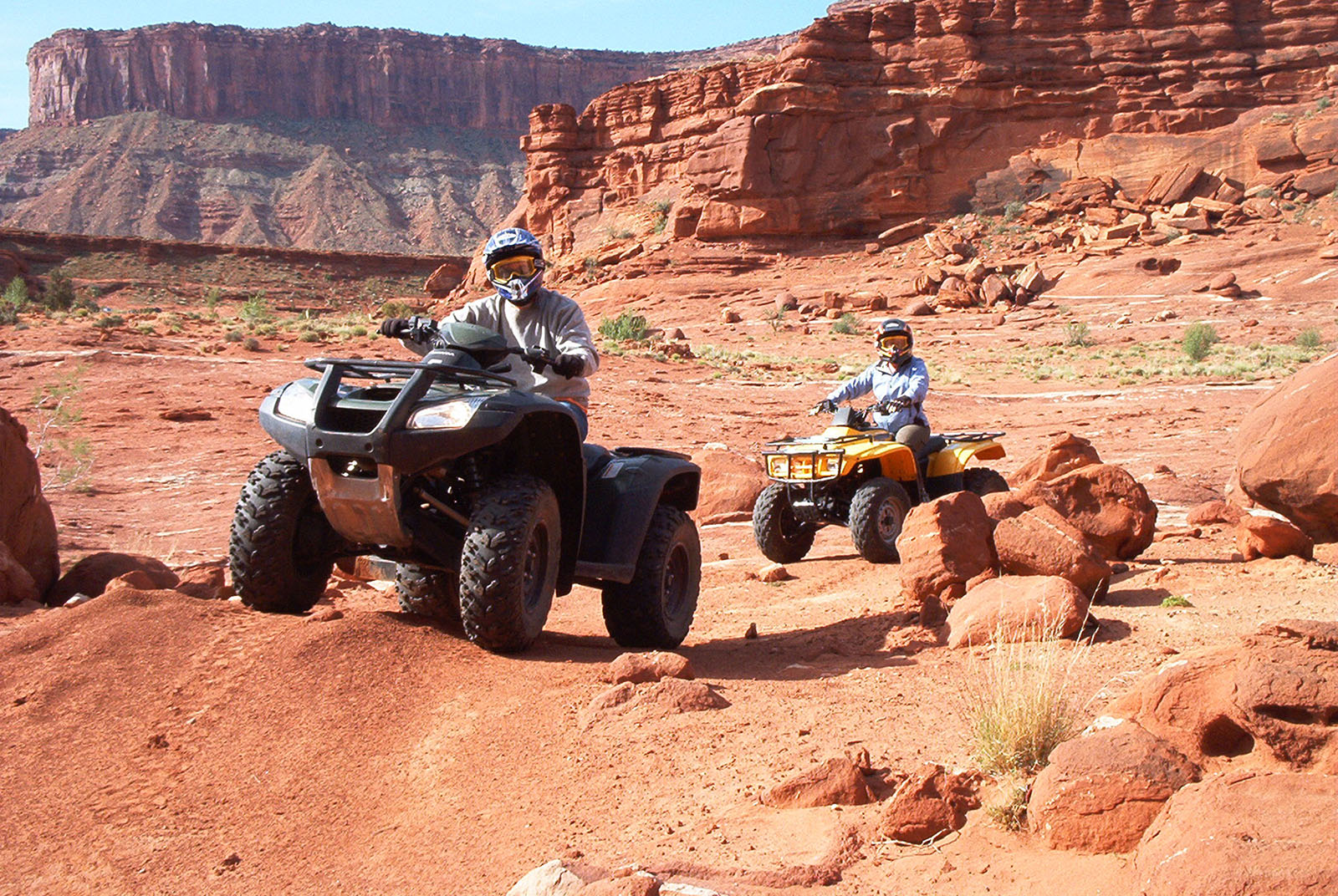
Moab is home to a wealth of trails that are perfect for exploring on an ATV or UTV. Much of the public land surrounding the national parks is open to ATV and UTV travel on designated routes. However, it’s important to note that riding these vehicles is not allowed within either Arches or Canyonlands National Parks.
ATV and UTV enthusiasts can take advantage of all the popular Moab 4WD trails, or venture out onto the many backcountry trails that surround Moab. Just remember that off-trail travel is illegal, and all motorized travel should be limited to designated routes only.
With the popularity of ATVs and UTVs on the rise, it’s important to approach this activity with a sense of responsibility. That means being prepared when you hit the trail, knowing proper trail etiquette, and doing your part to keep the land beautiful for generations to come. To help you get started, we’ve put together a quick video guide that covers everything you need to know before hitting the trails in Moab.
Sustainable Recreation
We ask for your cooperation in safeguarding your right to relish ATV/UTV riding in the Moab area by adhering to these guidelines:
- For street-legal ATV riders, we urge you to trailer your vehicles to the trailheads, when possible, and reduce in-town driving.
- If riding in town is necessary, kindly avoid passing through neighborhoods, and refrain from riding at night to ensure the privacy of residents.
- Please be mindful that the ATV speed limit in Moab is now 15 mph.
- While on the trails, be mindful of the fragile desert soils and refrain from causing damage.
- Please pack out everything you pack in, and dispose of human and pet waste responsibly.
Speed Limits for Street Legal ATV/UTVs
To minimize noise pollution and ensure the safety of all, it is required to follow the speed limits set for ATV/UTV riders within Moab. The in-town speed limit for ATV/UTVs is 15 mph, and Grand County has set a limit 10 mph lower than the posted speed limit for County B Roads. It is essential to respect these speed limits, as well as avoid driving through residential neighborhoods at night, to preserve the right to ride and provide solitude for residents. Let’s all do our part to minimize noise and respect our community.
Age Requirements
Anyone under 18 can operate an OHV on public land (no longer an 8-year-old minimum age requirement) if they are:
- Able to reach and operate each control necessary to safely operate the off-highway vehicle and;
- Have in their possession an OHV education certificate or a valid Driver’s License and;
- Under direct adult supervision
Adult supervision is required if:
- Under 18;
- Does not possess a valid driver’s license; and (Note: Learners permit requires licensed parent/guardian seated next to driver (adult supervision))
-
Operating an OHV on a public highway that is:
- Open to motor vehicles; and
- Not exclusively reserved for OHV use.
Helmet Requirements
Properly fastened helmet, having at least a “DOT Approved” safety rating for motorized use are required for all ATV/UTV operators and passengers under the age of 18 years. A properly fitting, safety rated helmet is the most important piece of safety gear available to an ATV/UTV rider.
Equipment Requirements
All ATV/UTVs are required to have certain equipment in working order while being operated in Utah, including:
- Brakes sufficient to stop and hold the machine
- A headlight and taillight while being operated between sunset and sunrise
- A brightly colored whip flag attached to the ATV/UTV and at least eight feet off the ground while being operated on designated sand dune areas
- A muffler and spark arrestor (snowmobiles are exempt from the spark arrestor requirement).
Street-Legal ATV/UTV Requirements
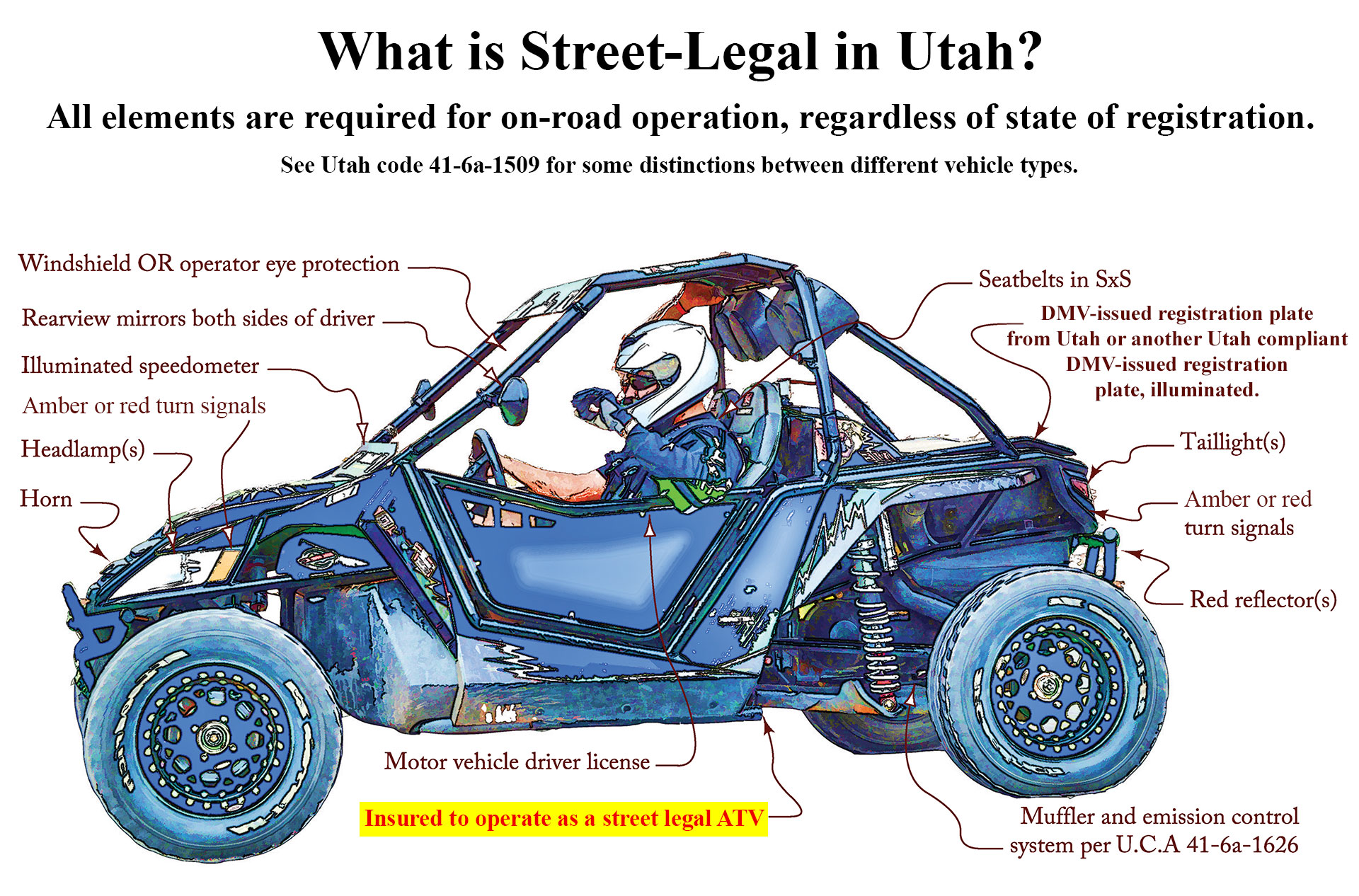
Your vehicle must have (1) a license plate from your home state and (2) meet all of the requirements shown below. If your home state does not issue license plates to ATVs, your vehicle cannot be street legal in Utah. If your vehicle is not street legal it must be trailered or towed to the trailheads.
ATV/UTV Registration
Mandatory Vehicle Education Course
Utah law now requires all OHV operators to complete the online Utah Off-Highway Vehicle Education Course. Operators under the age of 18 shall possess a youth OHV education certificate in order to operate an OHV on public land, road or trail. Operators 18 years of age or older may operate an OHV if they possess an approved adult OHV education certificate. Read more…
Residents
Any ATV?UTV being operated or transported on public lands, roads, or trails, of the State of Utah must display a current ATV/UTV registration sticker. All ATV/UTV registrations are handled by the Utah Division of Motor Vehicles.
Non-Residents
If a street-legal ATV/UTV is registered and has a license plate from your home state, and it meets all of Utah’s street-legal requirements (shown above), you do not need to purchase a Utah Non-Resident ATV/UTV Permit. If your vehicle is not street legal you need to purchase a permit online. The permits are $30 and are good for a full year. Please note that this permit is only for riding on Moab’s OHV trails, not on roads, streets and highways.
Revenues generated from OHV user fees are dedicated to construction, improvement, operation and maintenance of OHV trails.
For assistance with questions concerning OHV’s, along with online registation forms, visit:
Division of Outdoor Recreation
Website
1594 West North Temple, Ste 116
801-538-7433
White Wash Sand Dunes
One area that is particularly popular for riding ATV/UTVs is the White Wash Sand Dunes. The White Wash Sand Dunes are located 48 miles northwest of Moab, and 25 miles southeast of Green River. The Sand Dunes themselves are delineated and fenced for open OHV play; cross country travel is allowed only in the open area. Outside this area, there are hundreds of miles of designated roads and trails to be enjoyed. All motorized travel outside the open area must stay on the designated routes. Staying on the designated routes helps keep these routes open for your enjoyment. Damage to adjoining private property has occurred, and is a threat to your continued enjoyment of this area. Staying on designated routes assures that you will not trespass on private property. Please avoid the oil production facilities and the adjoining ranch, and never chase or harass livestock. When going through gates, leave them open or closed as you found them.
You must stay on designated roads and trails when riding outside the dune area. These routes are marked with white arrows and/or white paint. Bighorn sheep inhabit this area; riders should avoid stressing these animals by giving them the space they need. The cottonwood trees growing in the White Wash area are quite unique. Please avoid damaging these trees and give them a wide berth to reduce potential for soil compaction.
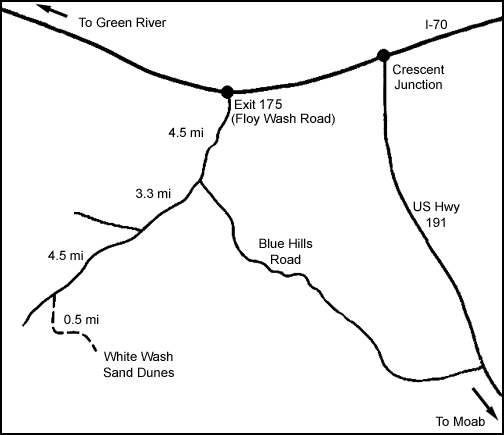
To reach the White Wash Sand Dunes from Moab drive 7 miles west of Highway 191 on I-70. Take Exit 175 (Floy) to the south. Continue southwest on the Floy Wash Road for 12 miles. Be sure to bear right 4.5 miles from I-70, and then continue straight at 7.8 miles from I-70. Go east (left) at 12.3 miles southwest of I-70. The trailhead latitude/longitude is 38.80348623, -110.0444765.
There are no facilities of any type at White Wash Sand Dunes. Visitors must pack out all trash. There is no drinking water in the area. If you camp, please use a previously used camping spot. Be advised that the closest dump stations are in the town of Green River. Specific campsites are not marked and portable toilets are required.
Trailer Parking
Need somewhere to to park your trailer? Although the City of Moab does not have any public long-term parking areas, we have a list of Moab companies that provide safe, secure trailer storage here.
Safety Tips
By following a few simple rules, OHV riders can make certain that every trip is a safe and enjoyable experience.
- Always ride in control. Ride within your abilities and your machine’s capabilities. Never attempt anything that is beyond your skill level.
- Always wear the appropriate safety gear. At a minimum, this should include a helmet, shatter resistant eye protection, long sleeves, long pants, gloves, and boots that cover the ankle.
- Only carry passengers if your OHV is specifically designed to do so. ATVs and off-road motorcycles are designed to be ridden by only one rider. Carrying passengers can alter the balance of the machine, causing a loss of control.
- Riders under the age of 16 should be supervised by a responsible adult at all times.
- Riders should be able to straddle the machine with a slight bend to the knees while both feet are on the footrests. Riding a machine that is too big is a major cause of injuries to young riders.
- Always tell someone where you are going and when you will return. Provide them with a map of your intended riding area.
- Be prepared for any emergency. Always carry a tool kit and spare parts, a first aid kit, and survival equipment when you ride. Carry plenty of extra food, water and fuel.
- Check the weather forecast before leaving home. For winter riders, always check the avalanche forecast before venturing into the back country. Avalanche information is available from the Avalanche Forecast Center at 801-364-1581
- Never, ever drink and ride. Alcohol and OHVs don’t mix, but create a deadly and illegal combination.
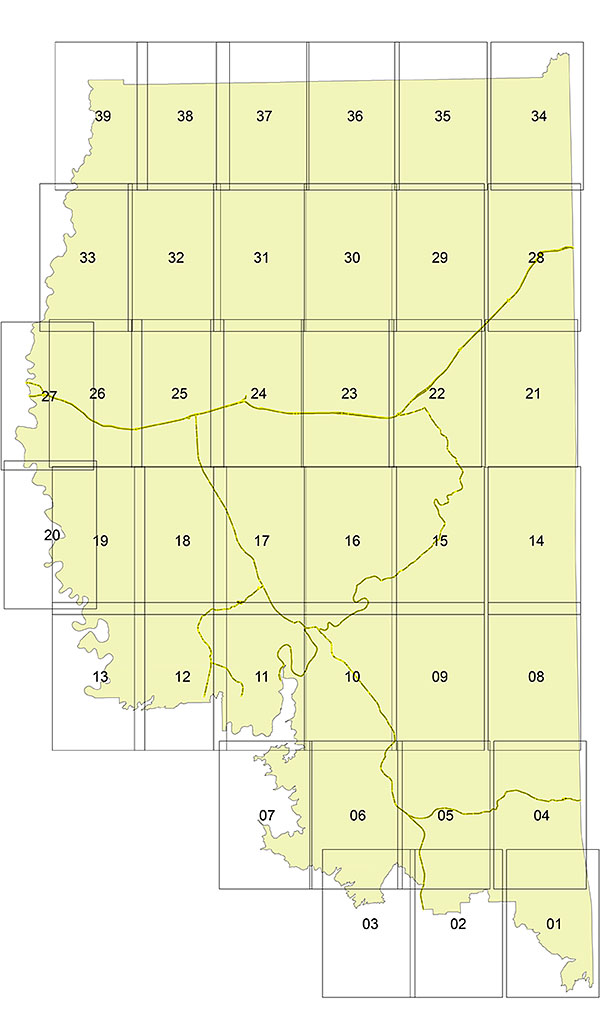
Bureau of Land Management (BLM) Motorized Travel Routes